Sunday, December 21, 2008
Grave of the Fireflies.
This movie was a little confusing. In the beginning the boy dies in the city, so I thought that something was going to happen in city to him, but it didn't. After his mom dies he just moves to smaller city with aunt. The movie was so sad. The boy's sister dies at end and I don't get why happened. The boy tried so hard and end up with nothing at the end of movie. Every time there seems to be hope, something really bad happens and the boy is worse off than before. It's depressing. I probably won't watch this movie again.

Japanese protest Google Street
http://www.brisbanetimes.com.au/news/technology/japanese-protest-google-street/2008/12/21/1229794286897.html
Once, I use Google Street in US. It was good that it shows what you will see on the way but there were people and cars on the pictures. While I work at school for website, I fount out that there are people who doesn't want their pictures on website. Japan is more busy cities. Many Japanese walk around the city. They don't know that they are on the pictures or not. Many Japanese entertainmenters have picture privacy that people cant use the pictures without asking the company. I think that Japanese take privacy very seriously.
Once, I use Google Street in US. It was good that it shows what you will see on the way but there were people and cars on the pictures. While I work at school for website, I fount out that there are people who doesn't want their pictures on website. Japan is more busy cities. Many Japanese walk around the city. They don't know that they are on the pictures or not. Many Japanese entertainmenters have picture privacy that people cant use the pictures without asking the company. I think that Japanese take privacy very seriously.
Tuesday, December 16, 2008
Trilateral Cooperation
http://mdn.mainichi.jp/perspectives/editorial/news/20081215p2a00m0na011000c.html
-Janice Kim
Calming Effects of Blue Lights.
http://www.yomiuri.co.jp/dy/national/20081211TDY02313.htm
I thought this article was very interesting. If blue lights do indeed decrease the amount of crimes where they are installed then it could make a huge impact on crime and suicide rates in Japan. However, without long term studies of the effects of blue lighting it will be impossible to tell if the blue lights are just making people go elsewhere or if they actually do calm the population.
I thought this article was very interesting. If blue lights do indeed decrease the amount of crimes where they are installed then it could make a huge impact on crime and suicide rates in Japan. However, without long term studies of the effects of blue lighting it will be impossible to tell if the blue lights are just making people go elsewhere or if they actually do calm the population.
Japanese karaoke!

Perhaps the greatest invention of all time and the best form of entertainment in Japan...Karaoke! Karaoke in Japan is all that you dreamed and more. With a number of friends you can pay for a private room for 1, 2, 3 or all night karaoke sessions. Usually this includes free drinks until the bar closes around 3 am. The drinks are usually syrupy concoctions but you can request straight liqueur and visit the equally free soda machine to create your own cocktails. Prices are incredibly reasonable. Some people will even pay for an all night karaoke booth over a hotel room in a big city if they are planning a late night anyway. Every karaoke bar has a book that includes English songs. There may not be the greatest selection but you can always find the classics as well as a surprising amount of new songs. The booths can fit up to 10 or 15 in most places. Language barriers can be a problem as it is much more difficult than you can imagine to sing in another language. But the experience can be a lot of fun with drunken Japanese singers excited to practice their English with the foreign visitor. Be warned however, the karaoke staff will not look fondly on this interruption and will scold you back to your room.
For more interesting visit this website:
http://www.japanvisitor.com/index.php?cID=359&pID=337
Manhole covers

Can you please tell me what the heck is the deal with all the pretty manhole covers in Japan? They can be so lovely that I've started taking pictures of them when I travel around the country. When I shared these sewer snaps on my photo blog, I got some interesting questions from friends and family at home. For example, does every city and town in Japan have a special manhole cover? And who is in the business of producing them?
Nicole C., Komono, Mie Prefecture
Dear Nicole,
You know why I love doing this column? Because every question opens my eyes to something new. I must pass over dozens of manholes every day, yet I've never given them more than a passing thought. And I've certainly never noticed any particularly pretty patterns. But a quick check on the Internet confirmed what you say — Japan has some very snazzy manholes, ranging from a stylized pine tree in Tokai, Ibaraki Prefecture, to the traditional doll adorning sewer tops in Kuroishi City up in Aomori.
This is all a relatively recent phenomenon, as I learned on a visit to the Japan Ground Manhole Association, a Tokyo-based alliance of the 32 companies that keep the country in manhole covers. Although Japan had sewage and drainage systems as early as the Yayoi Period (about 2,200 years ago), its first modern sewer systems, the subsurface kind with access points called manhoru (from the English word), were built in the late 19th century with the assistance of foreign engineers. For its manhole covers, Japan simply adopted the geometric designs already in use in other countries.
I should explain that there is more to manhole-cover design than meets the eye. The most important function of the raised design on manhole covers is not to look good, but to provide traction for the traffic moving over it. This is particularly important in wet weather, when manhole covers can be treacherously slippery, especially for two-wheeled conveyances such as motorcycles, scooters and bicycles. A good design, in terms of preventing slippage, will have multidirectional lines for better grip. Designs should also be recognizable no matter which direction they are viewed from, and have lasting appeal, since manhole covers last for decades at least, and often much longer.
By the late 1950s, a few of Japan's larger cities had developed original (but not very exciting) manhole-cover designs. When engineers from those cities moved out to help build sewer systems in other parts of the country, the manhole-cover designs went with them. This is why you see what's called the "Tokyo design" and the "Nagoya design" in many other cities and towns. But it wasn't until the '80s that Japanese manhole-cover design went designer.
According to Noboru Fujiwara of the manhole association, credit for the proliferation of patterns goes to a man named Yasutake Kameda, who was then a ranking bureaucrat in the construction ministry. At the time, only about 60 percent of Japanese households were hooked up to municipal sewer systems. To raise acceptance of these costly public works, mostly underground and largely underappreciated, Kameda thought the one part that is visible — the manhole covers on the surface — ought to be more attractive. In particular, he encouraged cities, towns and villages around Japan to develop designs with local appeal.
Custom covers cost on average about 5 percent more than off-the-rack designs, but even so, nearly 95 percent of the 1,780 municipalities in Japan now have a manhole-cover design to call their own. Trees and plants adorn nearly half of the designs, with official flowers being particularly popular. Animals, birds and local spots of natural beauty are also popular themes.
Given that just about anything can be turned into a hobby in Japan, it's no surprise that manhole diversification has spawned its own group of enthusiasts. There are a number of Web sites where manhoru mania (manhole fans) can trade information on attractive lids, and there's even a subgroup of people who make takuhon (rubbings) from manholes. Foreigners, too, have become captivated. Photos of Japanese manholes show up regularly on overseas sites, and an American woman named Shirley MacGregor has produced two books of quilting designs inspired by Japanese manhole covers.
Look under the lid and there's even more of interest about Japanese manholes. In many countries manholes are a source of noise pollution, because the covers rattle every time a vehicle moves over them, but that problem has been largely eliminated in Japan. In the '70s, in response to noise complaints, manufacturers introduced a tapered fit that has pretty much put the lid on rattling.
Japanese manholes also have advanced safety features developed specifically for local conditions. In a heavy, concentrated rainfall, especially on steep terrain, the air and water pressure inside a sewer can increase to the point that manhole covers are blown off and thrown as far as 10 meters. This is a hazard in and of itself, but a manhole left open is also very dangerous, particularly when obscured by raging waters. After two people died because they fell into open manholes during a storm in Kochi City in 1998, manufacturers developed a hinged safety system that holds the cover on while allowing pressure to escape. Once the pressure is off, the cover settles back into place. And just in case the system fails and the cover is blown off, new safety grills inside the opening are designed to prevent anyone from being swept into the open sewer.
The most up-to-date and comprehensive guide to Japanese manhole design is "Nihon no Manhoru" (1997), which provides photos and details on 1,546 different manhole cover designs from all around Japan. It's all in Japanese, but includes just enough English (the prefecture and town for each manhole) that you could track down designs you find attractive, or know what to look for when visiting a specific destination. The book is not available from online booksellers, but you or your local bookseller can order it for ¥6,300 from the publisher, Suido Sangyo Shinbun-sha (1-19-10 Toranomon,Minato-ku, Tokyo 105-0001; [03] 5251-0303; fax [03] 5251-3802; www.suidou.co.jp).
The manhole covers you see on the street are most likely to be atop sewers, but there are also manholes leading to storm drains, fresh-water supply pipes, telephone lines, fiber-optic cables, gas pipes and electric supply lines. In some communities, even the fire hydrants lie under street-level covers. All in all, there about 120 million covers in Japan, or one for every woman, child and man.
Monday, December 15, 2008
Wild boar goes on rampage in Wakayama; four injured
WAKAYAMA —
Four people were injured on Sunday when a wild boar attacked them in a residential area in Iwade City.
The boar first rammed a 14-year-old junior high school boy riding his bicycle, knocking him to the ground. His 11-year-old brother tried to run away, but the boar chased him and bit his left hand. The boar then used his front legs to attack a 15-year-old high school boy, and then rammed a 40-year-old man who had tried to seek refuge in the elementary school nearby. All four suffered bruises in the attack but were not seriously injured.
Police received several calls around noon saying there was a boar in the area, and two police officers rushed to the scene, where they battled for about 10 minutes to control the animal. Local hunters then killed the boar, which police said was a female about 2 years old, 1 meter long and weighing 80 kilograms.
The scene of the attack was several kilometers from the mountains. Police said there have been five instances of boars damaging crops this year, but that it is rare for them to venture into residential areas.
i always think it's interesting to hear about wildlife from other countries. I wasn't aware that there were wild boar attacks going on in Japan. It's a good thing that they stopped the animal, but it makes you wonder, what made it so agressive in the first place?
Sunday, December 14, 2008
Genki Drinks

Bottled EnergyDo Genki drinks have real fizz? TIME takes them for a road test When Japanese office workers need to get through another day of doing virtually nothing, they reach for genki drinks, supposedly stuffed with traditional well-being ingredients like ginseng or viper tincture. But are genki products just a waste of good Red Bull money? We analyzed four popular beverages using the most precise scientific method possible: Yuman Wong, TIME's newsdesk manager, guzzled and noted the results
SUBJECT: Chinese male, 55, no daily exercise, works 23 hours a day. H: 1.68 m, W: 71.66 kg
To finish reading go to: http://www.time.com/time/asia/features/asian_medicine/genki.html
I thought this article was interesting. It compared different kinds of these genki drinks. You have to read the comments the "subject" wrote down, it was funny most of the time. The article didn't actually have a conclusion to it...so I'm not sure if they are actually just a "waste of good red bull money."
Saturday, December 13, 2008
Vending-machine Heaven !!!
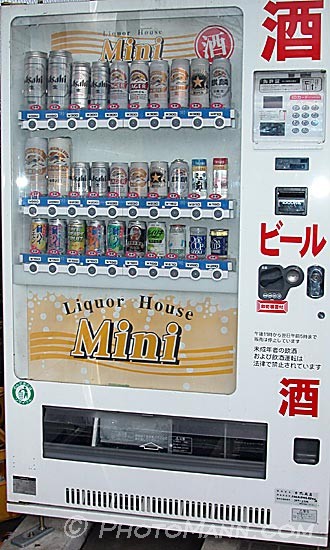

Japan is the vending-machine heaven ! Who really needs restaurants and supermarkets when you can get everything you want from vending machines? In America we are used to drinks and DVD movies vending machines but in Japan you can find fresh eggs , veggies and sake with a steaming bowl of oden. However, thats not all you can also get a bouquet of flowers,condoms,cigarettes and alcohol. But there's criticism about the last two. You can find vending machines in Japan almost in every corner and everywhere in front of shops, apartments and inside buildings. all these products and items and many more are available in vending machines. there are 5.51 million machines in Japan, taking a total of nearly$ 58 billion a year. The history of vending machines in Japan goes back to the Meiji Era, the oldest surviving machine is a wooden stamp- and card-selling device. Which is now exhibited in the Communication Museum in Tokyo's Chiyoda Ward.
I really wish if we have those kind of vending-machines in America!
For more information visit the article's page:
http://search.japantimes.co.jp/cgi-bin/fl20070415x2.html
I really wish if we have those kind of vending-machines in America!
For more information visit the article's page:
http://search.japantimes.co.jp/cgi-bin/fl20070415x2.html
And i also found this really good article on vending-machines in Japan, if you really like this topic you should give this page a visit because theres alot of information and good yet funny pictures.
http://www.boncherry.com/blog/tag/vending-machine/
Apple's Apples


I have known for years that the iPhone was extremely popular in Japan, especially with the number of requests I got from friends asking me to send them one.
However, one very avid Apple fan, decided to show his love for the iPod and Apple in a different way.
An owner of a Fuji apple orchard printed up custom stickers of iPods and the Apple logo. He then put the stickers on his Fuji apples while they were still young and on the trees.
A month later after the apples had matured, he removed the stickers.
As you can see the lack of sun reaching the apple cause them to keep the stickers original design.
No word as to what was done with the box of Geek Apples, but they did say they were quite delicious.
However, one very avid Apple fan, decided to show his love for the iPod and Apple in a different way.
An owner of a Fuji apple orchard printed up custom stickers of iPods and the Apple logo. He then put the stickers on his Fuji apples while they were still young and on the trees.
A month later after the apples had matured, he removed the stickers.
As you can see the lack of sun reaching the apple cause them to keep the stickers original design.
No word as to what was done with the box of Geek Apples, but they did say they were quite delicious.
I was amazed when I stumbled on to this. I thought it was a pretty cool idea. :) However, I don't agree with the writer's opinion on how this was 'geeky'. I don't think it was geeky at all but just an interesting experiment. We can see how technology has affected our lives...even the fruits we eat! There's been rumor that these apples' owner might be seeing a lawsuit from Apple.. I hope not!
Friday, December 12, 2008

Life beyond the universe
By Chris Betros
TOKYO —
When she was crowned Miss Universe 2007, Riyo Mori’s life underwent a big change. “I had worked so hard to become Miss Universe, and it was a dream coming true,” says Mori, who turns 22 on Christmas Eve. It has since been a whirlwind 18 months for Mori, and even though she is no longer the current Miss Universe, she keeps up a busy schedule of appearances at charity and promotional events.
“I thought life would be more relaxed but I am still busy,” says Mori who now speaks excellent English. “Last year when I won, Japan went crazy. Everywhere I went, people would recognize me and I felt like I had no life anymore. I was based in New York and visited many countries. I think I came back to Japan only three or four times.”
Born in Aoi, Shizuoka Prefecture, Mori studied jazz dancing from the age of four (her mother runs a dance school). At 16, she went to Canada where she studied at the Quinte Ballet School in Ontario. Her host mother was hearing impaired and Mori learned a little sign language and helped with deaf students sometimes. Before she was 19, she had a stint at the Radio City Rockettes Summer Intensive and was subsequently offered a place at the Broadway Dance Center in New York but had to decline after being accepted in the finals of Miss Universe Japan.
By the time she was crowned Miss Universe Japan, the confident Mori was referring to herself as a “modern-day female samurai.” She underwent further training on walking, talking and dressing under the tutelage of Miss Universe Japan director Ines Ligron before winning the crown on May 28, 2007. She recalls those heady days. “Looking back on it all, I was such a child. I can’t believe I said this or made that face.”
Mori says she matured in a hurry. “In New York, I took English lessons daily and had a tutor on how to speak to media. I got a shock one day when I was in Indonesia during my first month as Miss Universe. I was suddenly told I had to speak at a press conference. Well, I managed to talk for 10 minutes. I went through that sort of experience many times.”
Mori’s duties as Miss Universe 2007 took her all over the world, giving her the chance to meet many celebrities and world leaders. “I was most impressed by Jennifer Lopez. She was pregnant at the time and she had this aura. She is so professional.” And how about Donald Trump, who owns the Miss Universe pageant? “He was like a big daddy and very nice to me,” Mori says.
As a representative of the “new Japanese woman,” Mori had the challenge of correcting many misconceptions that people abroad have of Japanese. “There are still people who don’t know the difference between Japanese, Chinese and Koreans. I would tell them that we are all different and all special. We each have a beautiful culture. I am an ambassador for Japanese women and Japanese culture and that means more than geisha and sushi.”
Now that she is back in Japan, Mori finds herself a role model for thousands of young Japanese women. Indeed, the Miss Universe Japan competition has jumped in prestige since Kurara Chibana was named first runner-up in 2006. Mori, Chibana and this year’s Miss Universe Japan, Hiroko Mima, are inspiring a generation of young girls, with nearly 4,000 applications coming in for next year’s contest.
“Only one girl can be Miss Universe Japan, so my advice to them is: Even if you don’t win, you get so much out of it by just trying. You don’t have to be famous to make something out of your life. Young people are always looking for role models. It can be a singer or actress, but you should never forget who you are. Maybe some people think they want to be like me and that it is an honor. However, I don’t want them to forget who they are.”
Naturally, Mori receives a lot of comments on her blog. “I get many questions, usually about how to be beautiful. Younger women ask me how to be beautiful outside, what cosmetic products to use, how I do my makeup, and so on. Older women tend to ask about how I got my confidence, what mental preparation I do, that sort of thing.”
Mori says she doesn’t get recognized very often when she is out and about in Tokyo, “probably because I look very different when I have a day off. Many people think I got millions of dollars and lots of gorgeous clothes and accessories when I was Miss Universe but I don’t get to keep them. Interesting though, foreigners tend to know me more than Japanese. I was walking in Omotesando one day and a huge group from the Philippines recognized me.”
Although she is sought after to promote various cases, Mori says she wants to concentrate on raising awareness for HIV/AIDS charities. “When I was in New York, every weekend I went to a hospital for AIDS children to play with them. Traveling to many countries, I saw a lot of suffering in orphanages. It was very sad, but I was prepared mentally for that. It just reinforced my desire to do something to help. Nobody talks about this issue in Japan.”
Her other ambition is to open an international dancing school, and maybe one day become a Broadway dancer. “I still dance and I love teaching,” she says. For relaxation, Mori has started hot yoga. She also likes redecorating (“not that I get many chances to do it,” she jokes).
Mori says one of the best legacies of her reign as Miss Universe are the many friends she has made. She even had a memorable reunion with her homestay family in Ontario. “They had been so surprised when they saw that I won Miss Universe. It was a really fun time when I went back.”
http://www.japantoday.com/category/entertainment-arts/view/life-beyond-the-universe
When I found out that Mori won the Miss Universe 2007 title, I was so happy for her. Finally, an Asian person was able to receive that title. After reading this article, I can tell that not only she had so much fun on her 18 months journey, she also learned a lot and benefit much more than she could imagined. It was a dream come true. It will be nice if I could be one someday...someday :)
Tobacco tax hike shelved
The government and the ruling parties decided Thursday to shelve a plan to raise the tobacco tax, one of the key elements of tax reform for fiscal 2009, according to government sources.
The ruling coalition is to finalize the outline of its tax system reforms for fiscal 2009 on Friday, the sources said.
Following the decision, Prime Minister Taro Aso ordered Liberal Democratic Party Policy Research Council Chairman Kosuke Hori to find an alternative source of revenue to the tobacco tax hike.
The prime minister told Hori that the government's goal of curbing natural increases in social security spending by 220 billion yen each fiscal year is reaching its limits.
"If it's impossible to use increased revenue from the tobacco tax hike [to fund social security costs], we'll need alternatives to cover the shortfall. I'd like you to take full responsibility for finding a solution," Aso reportedly told Hori. Hori reportedly accepted the prime minister's request.
The government had studied a possible tobacco hike as a stable revenue source to enable it to reduce cuts to the projected natural annual increases in social security spending.
But the plan to raise the tobacco tax faced growing opposition from some LDP and New Komeito members that insisted there was no guarantee that the tobacco tax hike would help boost tax revenue.
With the tax hike having been shelved, Aso faces the difficult task of finding an alternative way of boosting social security funding, observers say.
Hori and his New Komeito counterpart Natsuo Yamaguchi agreed earlier in the day to thrash out concrete measures as soon as possible to achieve the government's goal of maintaining the policy of reducing the natural increase in social security expenditures by 220 billion yen annually.
http://www.yomiuri.co.jp/dy/national/20081212TDY01304.htm
Thursday, December 11, 2008
Ex-boxer Yamato avoids jail for assault
The Yomiuri Shimbun
The Tokyo District Court on Tuesday sentenced boxer-turned-actor Takeshi Yamato to 18 months' imprisonment, suspended for four years, for assaulting the owner of a Tokyo sushi restaurant in August by punching him in the face.
According to the court ruling, the 43-year-old Yamato, whose real name is Yoshimitsu Eguchi, became angry when the owner asked him not to come to the restaurant in Meguro Ward again because of his misbehavior there.
Yamato brandished a knife and threatened to kill the owner before punching him, causing an injury that took two weeks to heal.
Yamato, a former Japan middleweight boxing champion, appeared in the "Ultraman" TV series as an actor.
(Dec. 3, 2008)
I liked this article, it is entertaining and also interesting to hear about someone in Japan threatening someone's life. I think alot of time this stuff goes unnoticed but considering the circumstances, the guy being an ex-boxer/celebrity, it was hard to ignore.
The Yomiuri Shimbun
The Tokyo District Court on Tuesday sentenced boxer-turned-actor Takeshi Yamato to 18 months' imprisonment, suspended for four years, for assaulting the owner of a Tokyo sushi restaurant in August by punching him in the face.
According to the court ruling, the 43-year-old Yamato, whose real name is Yoshimitsu Eguchi, became angry when the owner asked him not to come to the restaurant in Meguro Ward again because of his misbehavior there.
Yamato brandished a knife and threatened to kill the owner before punching him, causing an injury that took two weeks to heal.
Yamato, a former Japan middleweight boxing champion, appeared in the "Ultraman" TV series as an actor.
(Dec. 3, 2008)
I liked this article, it is entertaining and also interesting to hear about someone in Japan threatening someone's life. I think alot of time this stuff goes unnoticed but considering the circumstances, the guy being an ex-boxer/celebrity, it was hard to ignore.
Japan scientists eye made-to-order bones
Japanese hospitals are running a clinical trial on the world's first custom-made bones which would fit neatly into patients' skulls and eventually give way to real bones.
Basically defected bones can fixed by transplanting real bones or using substitutes, materials such as ceramic substitutes. New bone transplant using powdered calcium phosphate, the elements that make up actual bones.
The new implants are called CT Bone as they are crafted using the patient's computer tomography (CT) data, a form of medical imaging, in order to accurately use these CT bone implants. CT data copies details like jaw, chin and other details of the skull down to one millimetre (0.039 of an inch), a level significant enough to make a difference in human faces.
These custom bones can be generated within hours from for example an accident, but this kind of new technology is only currently used on skull bones because, unlike body parts, it doesn't have to carry the body weight.
The new implants can even replace your own bone, which was not possible in the past. Its pretty interesting how things have evolved and how technology has gotten so far that medical issues can be solved quicker and efficiently. We have gotten to a point where computers can do things like save peoples exact facial skeletal structure, and if you think about it, that is pretty far, and those can be applied to machines in order to create those exact features, for example the new transplants CT Bones.
Read more on the Article on :
http://www.physorg.com/news146641965.html
Its really interesting.
Basically defected bones can fixed by transplanting real bones or using substitutes, materials such as ceramic substitutes. New bone transplant using powdered calcium phosphate, the elements that make up actual bones.
The new implants are called CT Bone as they are crafted using the patient's computer tomography (CT) data, a form of medical imaging, in order to accurately use these CT bone implants. CT data copies details like jaw, chin and other details of the skull down to one millimetre (0.039 of an inch), a level significant enough to make a difference in human faces.
These custom bones can be generated within hours from for example an accident, but this kind of new technology is only currently used on skull bones because, unlike body parts, it doesn't have to carry the body weight.
The new implants can even replace your own bone, which was not possible in the past. Its pretty interesting how things have evolved and how technology has gotten so far that medical issues can be solved quicker and efficiently. We have gotten to a point where computers can do things like save peoples exact facial skeletal structure, and if you think about it, that is pretty far, and those can be applied to machines in order to create those exact features, for example the new transplants CT Bones.
Read more on the Article on :
http://www.physorg.com/news146641965.html
Its really interesting.
Wednesday, December 10, 2008
Blu Ray Records surpass DVD recorders


In North America, though it continues to trail DVD as most consumers seem unwilling to trade their DVD players for a Blu-ray one.
Not so in Japan. Blu-ray disc recorders surpassed a 50 percent market share in the first week of November and outpaced sales of DVD disc recorders, says market research company GfK Retail and Technology. That compares to about 10 percent market share that they had just about a year ago.
Average sales price of Blu-ray recorders have been falling this year. In the first week of June 2008, the average price of a Blu-ray recorder was between the equivalent of $1,110 to $1,300. Now they are available at the sub-$1,000 level, says the firm.
Blu-ray disc recorders are replacing DVD recorders at about one-and-a-half times faster than DVD recorders replaced VHS recorders, says GfK.
One of the reasons for this quicker rate of change is the rise in sales of flat panel TVs, says GfK. Blu-ray recorders can record digital high definition broadcasting without any drop in quality, which has ostensibly helped accelerate demand for it.
Photo: Panasonic Blu-ray recorder (soozums/Flickr)
Updated: To correct pricing error of recorders.http://blog.wired.com/gadgets/2008/12/blu-ray-player.html
Japan Hot Stocks-Capcom, chip-related, shippers, Toyota
Thomson Financial News
Japan Hot Stocks-Capcom, chip-related, shippers, Toyota
12.10.08, 12:07 AM EST
TOKYO, Dec 10 (Reuters) - The benchmark Nikkei average gained 3.2 percent and the broader TOPIX rose 2.1 percent as of 0445 GMT on Wednesday.
**CAPCOM DROPS AFTER EA OF U.S. CUTS OUTLOOK**
Japanese videogame maker Capcom Co Ltd dropped 4.8 percent to 2,070 yen after U.S. videogame publisher Electronic Arts Inc
Last month, major electronics retailer Circuit City Stores Inc
0444 GMT
**CHIP-RELATED SHARES GAIN AFTER JUMP IN CHIP INDEX**
Shares of semiconductor equipment makers such as Tokyo Electron Ltd gained after the Philadelphia Stock Exchange Semiconductor Index rose nearly 5 percent the previous day.
Shares of Tokyo Electron surged 10.2 percent to 2,695 yen, while Advantest Corp
0427 GMT
**SHIPPERS JUMP ON BALTIC INDEX REBOUND**
Mitsui OSK Lines Ltd, operator of the world's biggest fleet of bulkers for shipping iron ore, jumped 9 percent to 543 yen, while Nippon Yusen KK, Japan's biggest shipping company in terms of sales, gained 6.1 percent to 526 yen.
The Baltic Dry Index, the global freight index of prices for shipping commodities, inched up 1.2 percent on Tuesday, its first gains since mid-November, amid rising steel prices and firm iron ore prices.
0200 GMT
**TOYOTA WEAK; GOLDMAN SLASHES PROFIT FORECAST**
Toyota Motor Corp
The new forecast would be a fraction of the 2.27 trillion yen Toyota made in operating profit last year. The transport sector subindex was up 1.3 percent.
0155 GMT
**PROPERTY DEVELOPERS SOAR ON GOVT EMERGENCY PACKAGE REPORT**
Tokyu Land Corp soared 16.1 percent to 318 yen and other mid-sized property developers and REITs also rallied after the Nikkei business daily said the Japanese government has decided to extend credit lines of up to 2 billion yen ($21.71 million) to cash-strapped small and midsized developers to help them avoid bankruptcy.
The programme will be part of emergency steps the government plans to announce as early as Monday, said the report. The government is also considering a low interest rate loan programme for REITs (real estate investment trusts), the report said.
Property developer Goldcrest Co jumped 8 percent to 2,105 yen and Atrium Co leapt 13.2 percent to 232 yen. Among REITs, Pacific Holdings Inc gained 13.7 percent to 233 yen.
0117 GMT
**ELPIDA RISES, LIKELY TO REDEEM CONVERTIBLE BOND**
Shares of Elpida Memory rose 12.2 percent to 443 yen ahead of a deadline on Thursday that will likely trigger the redemption of a 50 billion yen ($542.7 million) convertible bond that could have led to a big increase in the number of its outstanding shares.
Elpida, a maker of memory chips, issued the bond to Nomura Holdings in November to fund investment. The announcement of the bond, which could boost outstanding shares by three-quarters, led to a sharp sell-off of Elpida's shares.
Elpida's stock is set to close below the conversion price of 509 yen for a 19th straight day. Under the agreement with Nomura, Elpida has to redeem the bond in full if its stock closes below that level for 20 straight trading days.
0050 GMT
**NIPPON ELECTRIC GLASS SLIDES AFTER FORECAST CUT**
Shares of Nippon Electric Glass were down 3.9 percent at 474 yen after saying its operating profit would likely fall 55-65 percent in the October-December quarter compared with a year earlier, hit by slumping demand for glass used in liquid crystal displays.
The forecast marks a sharp downward revision to its previous estimate for a fall in quarterly profit of 5 to 15 percent.
0014 GMT
**SONY CORP> DOWN AFTER RESTRUCTURING ANNOUNCEMENT**
Sony
0006 GMT
(For IPO news, data and diary, click, for stocks click)
(Reporting by Elaine Lies)
((elaine.lies@thomsonreuters.com; +81 3 6441 1807; Reuters Messaging:elaine.lies.reuters.com@reuters.net))
($1=92.14 Yen) ($1=92.14 Yen) Keywords: MARKETS JAPAN STOCKS HOT =2
(Multimedia versions of Reuters Top News are now available for: * 3000 Xtra : visit http://topnews.session.rservices.com * BridgeStation: view story .134 * Reuters Plus: from your WebDSS screen For more information on Top News, visit http://topnews.reuters.com)
COPYRIGHT
Copyright Thomson Reuters 2008. All rights reserved.
The copying, republication or redistribution of Reuters News Content, including by framing or similar means, is expressly prohibited without the prior written consent of Thomson Reuters.
http://www.forbes.com/afxnewslimited/feeds/afx/2008/12/10/afx5801627.html
Brian Yoo
Tuesday, December 9, 2008
Nintendo Wii sales in Japan top 7 million
In the past two years since the Nintendo Wii have launch on Dec. 2, 2006 it have out sold other game consoles such as PlayStation 3 with over 2 million and Xbox 360 with over 700,000. While the Wii was 7 million. Over 24 million Nintendo handheld DS consoles was sold. I didn't doubt that Nintendo Wii sold this much since this game console actually make the player more active. You don't just sit there and push buttons. Some game you would need to jump, punch, or any other motions.
http://www.japantoday.com/category/technology/view/nintendo-wii-sales-in-japan-top-7-million
http://www.japantoday.com/category/technology/view/nintendo-wii-sales-in-japan-top-7-million
Japan toughens up on Internet regulation

in this article, there was a major concern about japan's internet regulation. there might be a governmental involvement of those files online such as file sharing and communication. there was a final regulation which was relased on Dec 6th that targeted all web content including blogs and web pages. on dec 10 there was another regulation that was passed but this time it includes mobil phones that filter accessing web pages for minors. File sharing, on the other hand, was one of the main concern that we discussed on Dec 18th. Athoroties are baning those content to reserve its copy right..
here is the link of the Article
http://search.japantimes.co.jp/cgi-bin/nc20080116a1.html
Abdullah Al Saka
Global Job cuts
Sony cutting 8,000 jobs amid global downturn
Tuesday 09th December, 03:42 PM JST
TOKYO —
Sony is slashing 8,000 jobs, or 4% of its global work force, aiming to cut costs by $1.1 billion a year as a global downturn and stronger yen batters profits at the Japanese electronics maker.Sony Corp, which has 185,000 employees worldwide, said Tuesday it will complete the layoffs by the end of March, 2010. It did not give a country breakdown for the job cuts but said they will come from its electronics business, which has 160,000 workers.
The company—maker of the Walkman portable player and PlayStation 3 game console—also has movie, video game and financial businesses.
Sony’s announcement comes amid a slew of similar news from Japanese manufacturers, who face nose-diving demand at home and abroad. The electronics industry has been hurt by plunging gadget prices, currency fluctuations, intense competition and a global slowdown in consumer spending.
The company makes about 80 percent of its sales overseas and is vulnerable to a stronger yen, which erodes foreign earnings. The dollar has sunk to about 93 yen from 117 yen last year.
Sony has cut production and lowered inventories, but tough times demand more drastic efforts, it said in a statement.
The job cuts and other changes will deliver more than 100 billion yen in cost savings a year by March 2010, according to Sony.
The cost-cutting plan includes postponing an investment to boost production of liquid crystal display TVs in Slovakia because of a plunge in European demand for flat-panel TVs.
“These initiatives are in response to the sudden and rapid changes in the global economic environment,” Sony said.
Sony will end production at some plants, including one in France that makes tape and other recording media and will continue moving electronics production to lower-cost countries. Manufacturing sites will be reduced by about 10% from 57 today.
Sony will also trim spending in semiconductors, and will outsource a portion of the production it had planned for image sensors for mobile phones.
The cost of the job cuts and plant shutdowns will be disclosed next year when the company updates its forecast for the fiscal year, the company said.
Sony recently slashed its full-year earnings projection, citing weaker consumer demand and a stronger yen. For the fiscal year through March 2009, it is expecting a 150 billion yen profit, down 59% from the previous year.
The yen’s recent jump was set off by panicky international investors rushing to unwind yen “carry” trades, which had taken advantage of Japan’s low interest rates to borrow yen to invest elsewhere. Reversing those trades means buying back the yen, lifting its value.
Sony’s July-September profit plunged 72% from a year earlier to 20.8 billion.
http://www.japantoday.com/category/business/view/sony-cutting-8000-jobs-amid-global-downturn
Japanese to Arrest Anti-Whaling Activists.
TOKYO —12/7/08
Anti-whaling activists will be arrested if they forcibly interrupt Japan’s whale hunting in the Antarctic Ocean, a report said Saturday.
The fisheries agency and justice ministry made the decision as a boat belonging to the U.S.-based Sea Shepherd Conservation Society set sail from Australia in a bid to disrupt the Japanese whaling fleet, the Sankei Shimbun said.
Crew members from Japan’s fleet would capture activists and hand them over to the Japanese Coastguard if they board the whalers, the report in the daily added.
If arrested by the coast guard, they would be charged with forcible obstruction of business under Japanese law.
During the last Antarctic hunt, Japan alleged that Sea Shepherd activists tracked down and hurled bottles of chemicals at the fleet to disrupt operations, leading Japan to label them “terrorists.”
Two activists boarded a Japanese whaler in January, sparking a two-day standoff before they were handed over to an Australian customs vessel.
Japan’s fleet set off in mid-November heading for the Antarctic Ocean with plans to slaughter hundreds of whales, despite strong opposition from Australia and New Zealand, where whale-watching is a popular pastime.
Japanese whalers kill about 1,000 whales a year using a loophole in a 1986 global whaling moratorium that allows “lethal research” on the ocean giants.
Tokyo makes no secret of the fact that the meat ends up on dinner tables and accuses Westerners of insensitivity to its whaling culture. Only Norway and Iceland defy the whaling moratorium outright.
I'm an animal lover myself, and this is extremely unfortunate that all these whales are being killed under false pretenses, but people bombing other people is way too extreme. With that being said, maybe all "loopholes," that whalers are finding that allow them to hunt whale should be changed so that whale hunting (in all it's categories) can be put to a stop.
http://www.japantoday.com/category/crime/view/japan-to-arrest-anti-whaling-activists-newspaper-reports
Anti-whaling activists will be arrested if they forcibly interrupt Japan’s whale hunting in the Antarctic Ocean, a report said Saturday.
The fisheries agency and justice ministry made the decision as a boat belonging to the U.S.-based Sea Shepherd Conservation Society set sail from Australia in a bid to disrupt the Japanese whaling fleet, the Sankei Shimbun said.
Crew members from Japan’s fleet would capture activists and hand them over to the Japanese Coastguard if they board the whalers, the report in the daily added.
If arrested by the coast guard, they would be charged with forcible obstruction of business under Japanese law.
During the last Antarctic hunt, Japan alleged that Sea Shepherd activists tracked down and hurled bottles of chemicals at the fleet to disrupt operations, leading Japan to label them “terrorists.”
Two activists boarded a Japanese whaler in January, sparking a two-day standoff before they were handed over to an Australian customs vessel.
Japan’s fleet set off in mid-November heading for the Antarctic Ocean with plans to slaughter hundreds of whales, despite strong opposition from Australia and New Zealand, where whale-watching is a popular pastime.
Japanese whalers kill about 1,000 whales a year using a loophole in a 1986 global whaling moratorium that allows “lethal research” on the ocean giants.
Tokyo makes no secret of the fact that the meat ends up on dinner tables and accuses Westerners of insensitivity to its whaling culture. Only Norway and Iceland defy the whaling moratorium outright.
I'm an animal lover myself, and this is extremely unfortunate that all these whales are being killed under false pretenses, but people bombing other people is way too extreme. With that being said, maybe all "loopholes," that whalers are finding that allow them to hunt whale should be changed so that whale hunting (in all it's categories) can be put to a stop.
http://www.japantoday.com/category/crime/view/japan-to-arrest-anti-whaling-activists-newspaper-reports
Monday, December 8, 2008
Student attempts hydrogen sulfide gas suicide at Kobe International University
On December 7, a 20-year old male student attempted to kill himself with hydrogen sulfide gas on the campus of Kobe International University in the Hyogo prefecture. He was critically injured and was sent to the hospital right away for serious treatment. I think it's sad that anyone who has lived up to their lives at this stage is so easy to give up on life. Sad indeed.
http://www.japantoday.com/category/national/view/student-attempts-hydrogen-sulfide-gas-suicide-at-kobe-international-university
http://www.japantoday.com/category/national/view/student-attempts-hydrogen-sulfide-gas-suicide-at-kobe-international-university
Friday, December 5, 2008
Textbook screening in Japan
Thought this was an interesting article after our recent class discusion on education in Japan. It makes one consider the various perspectives nations can take in regard particularly to the documentation of history and modern methods of education. Think about your textbook for a moment, whose version are you reading...
http://www.asahi.com/english/Herald-asahi/TKY200812040373.html
http://www.asahi.com/english/Herald-asahi/TKY200812040373.html
Tuesday, December 2, 2008
Firms see economy in decline
99 of 100 corporations surveyed by The Asahi Shimbun in November said the economy was worsening. About 70 respondents said they did not think economy will be recovered soon.
It was the first time in 7 years that more than 90% of respondents had said the economy was worsening. Moreover, nearly 70 companies said the economy would not recover in 2009, and none expected a recovery during the first half of 2009.
http://www.asahi.com/english/Herald-asahi/TKY200812010061.html
It was the first time in 7 years that more than 90% of respondents had said the economy was worsening. Moreover, nearly 70 companies said the economy would not recover in 2009, and none expected a recovery during the first half of 2009.
http://www.asahi.com/english/Herald-asahi/TKY200812010061.html
Proposal calls for 30 percent cut in big-eyed tuna catch
Big-eyed tuna catches need to be cut by 30 percent, says the Commission for the Conservation and Management of Highly Migratory Fish Stocks in the Western and Central Pacific Ocean (WCPFC).
The proposal will be tabled at the commission's next annual meeting in Pusan, South Korea, on Dec. 8. Japan, which primarily fishes in the area, has decided to comply with the proposal to reduce its catch by 30 percent over three years from 2009.
The move comes just as a dispute over the reduction of catch size for Pacific bluefin tuna in the Atlantic Ocean has been settled. The new proposal, which affects big-eyed and yellowfin tuna, is likely to have a knock-on effect on the price of tuna sashimi.
Big-eyed tuna are usually caught in round nets, which also scoop up younger fish, thus adversely affecting the total population. Between 2003 and 2006, the commission recommended an average catch reduction of 30 percent.
A plan last year to reduce catch size by 25 percent failed due to differences of opinion between committee member states.
(Mainichi Japan) December 2, 2008
The proposal will be tabled at the commission's next annual meeting in Pusan, South Korea, on Dec. 8. Japan, which primarily fishes in the area, has decided to comply with the proposal to reduce its catch by 30 percent over three years from 2009.
The move comes just as a dispute over the reduction of catch size for Pacific bluefin tuna in the Atlantic Ocean has been settled. The new proposal, which affects big-eyed and yellowfin tuna, is likely to have a knock-on effect on the price of tuna sashimi.
Big-eyed tuna are usually caught in round nets, which also scoop up younger fish, thus adversely affecting the total population. Between 2003 and 2006, the commission recommended an average catch reduction of 30 percent.
A plan last year to reduce catch size by 25 percent failed due to differences of opinion between committee member states.
(Mainichi Japan) December 2, 2008
Hell's Seniors
I found this article pretty interesting just because it turns our normal conception of the elderly around. I also found the discussion of potential causes behind this problem to be particularly of interest. We normally think in terms of society "failing" the youth and "leading" them into criminal activity, but the old can be affected by the same circumstances. Crime Problem in Japan: Elders
Subscribe to:
Posts (Atom)